Bandeira do Brasil

Bandeira do Brasil

Wednesday, July 10, 2013

ARE YOU INTO ACOUSTIC GUITAR?

Then meet Robson Miguel, one of the ten best acoustic guitar players of the world. 
Robson Miguel is from Ribeirão Pires, Sao Paulo. He is also an internationally recognized virtuoso, justly  honored with numerous titles  and awards in Brazil, Latin America, Europe and Japan. He gives everyone the opportunity to meet fascinating passages of our history and indigenous culture, mixed with the rare pleasure of the eclecticism of his music, while disclosing the name of his  town in his travels throughout Brazil and worldwide. He is also a legitimate representative of  the indigenous culture as a unique  Guarani mestizo chief of the country, along with his lovely wife, Tikuna, We'e'ena. Together, they help  spread the musical culture with rare erudition and comprehensiveness, defend  indigenous causes and do extensive research and surveys about their culture in the ABC region and beyond, besides helping to correct mistakes on how we see the secular indigenous customs, always with the relentless optimistic naiveté and energetic characteristics of their ethnicities and training.


Tuesday, July 2, 2013

DIVING THROUGH THE EYES OF A SEA TURTLE

The following video shows  a camera placed on top of a turtle´s  shell and the images reveal the animal´s perspective.  Some little turtles were also monitored throughout the Brazilian coast.

During the night there is some stir in the sand. All of a sudden a newborn pops out. A couple of minutes later the nest  yields tens of little turtles which by instinct run towards the sea. The beach is teeming with predators. Every year, around one million young turtles  are born at the Brazilian beaches, but out in the wild, only one in a thousand reaches  adult life.

The first day is the most dangerous. The little ones who survive the attacks and manage to get to the water still have to face attacks by birds and fish. What happens to them from this moment on is a mistery. Where do they go? Where do they feed? In an attempt to answer  such questions researchers from the Tamar Project and the Florida Atlantic University are working together on a singular project – a  camera placed on the back of a  turtle reveals  it all. 

Our friend swam among sharks, made some beautiful underwater images at the Bahia seashore.  But the researchers want to know more. For the first time they attached chips to little turtles and tracked down their whereabouts  by satellites in their first months of marine life.

Kate Mansfield, the American biologist, adapted transmitters used on birds.  The greatest challenge, according to her, is to keep the transmitter attached to the offspring´s shell. Due to the young turtles´ quick growth, the transmitter would easily detach . The answer came to Katie when she was at the manicurist.  As the shell  and our nails are pretty much alike, I decided to  sandpaper it a little before applying an acrylic foundation.  Silicon helps hold it together.  The battery is solar powered and lasts  10 hours; recharging takes two days.

We left the base of the Tamar Project at Praia do Forte, northern Bahia, and headed 10 kilometers offshore to release three young turtles.  The first turtle is the oldest, 11 months old and about 7 inches long.  The other two are younger, 4 and a half months old and about 5 inches long. If the turtles are too small, there is no way of attaching the transmitters to them.  It was first developed in lab conditions so as to demonstrate no harm was done to the animals and nor their behavior was affected by the transmitters.

After the turtles  are released into the sea, their coordinates are marked. The equipment contains buoys and GPS devices and also sails – its mains purpose is to show the currents patterns in the surroundings.  One of the animals  is released close to the equipment .
The older turtle went southwards, and soon went  off  the coast, in oceanic waters and then  changed its course, northbound.  After 43 days it stopped transmitting signals. It had swum 1,215 kilometers (754,97 miles).
One of the smaller turtles went off the coast, returned and went northwards. It stopped transmitting after 68 days, offshore Pernambuco state, after swimming 2,581 km ( 1,603.76 miles).
The other little turtle went south, along the shore, and after 100 days, it is still sending signals. According to the last recording it had swum 2,385 km (1,481.97 miles)  and  was next to Sao Paulo state.

The researcher states that the purpose is to reveal what happens in the first year of life, currents and winds being strong determinants. Such study will be tallied with results from transmitters placed on adult turtles. The adult ones which had been monitored went north and fed themselves next to the Ceara state. By the time they were tracked down,  the current was northbound.

When the Tamar Project was launched 33 years ago, the marine turtles were threatened by extinction due to predatory fishing. On account  of  research and preservation measures the number of females appearing on the Brazilian coast  went tenfold.  By understanding their behavior patterns we can develop preemptive measures to avoid threats to the species. 


Want to engage in satellite tracking? Try this site

Thursday, June 27, 2013

COME SWIM IN THE DESERT

Composed of large, white, sweeping dunes, at first glance Lençóis Maranhenses looks like an archetypal desert. In fact it isn't actually a desert. Lying just outside the Amazon Basin, the region is subject to a regular rain season during the beginning of the year. The rains cause a peculiar phenomenon: fresh water collects in the valleys between sand dunes, spotting the desert with blue and green lagoons that reach their fullest between July and September.
The area is also surprisingly home to a variety of fish which, despite the almost complete disappearance of the lagoons during the dry season, have their eggs brought from the sea by birds.
Some lagoons are more famous, such as Azul, Preguiça and Peixes, which comprise one of the park's main touristic sites. More time and energy are necessary to reach the 15-meter wide Bonita lake, the biggest in the region. It takes a little more than 50 minutes bouncing in a jeep and then a climb up a 30-meter high dune. The view from the top, however, erases any memories of the hardships. 
WHAT YOU NEED TO KNOW ABOUT LENÇÓIS
WHEN TO VISIT
It's best to go between May (rainy season) and August; in these months, the lagoons are fuller
TEMPERATURE
Annual average of 26°C    
VACCINE
Not mandatory
OFFCIAL WEBSITE
www.turismo.ma.gov.br
HOW TO GET THERE
SP-São Luís-SP
TAM: tickets start at R$ 588*
Azul (via Belo Horizonte): tickets start at R$ 639.80**
Gol (outbound via Rio; returning via Brasilia): tickets starting at R$ 859.80**
AIRLINES
Azul: 4003-1118; www.voeazul.com.br
Gol: 0300-1152121; www.voegol.com.br
TAM: 4002-5700; tam.com.br
* Leaving from Guarulhos airport
** Leaving from Campinas airport


Tuesday, June 18, 2013

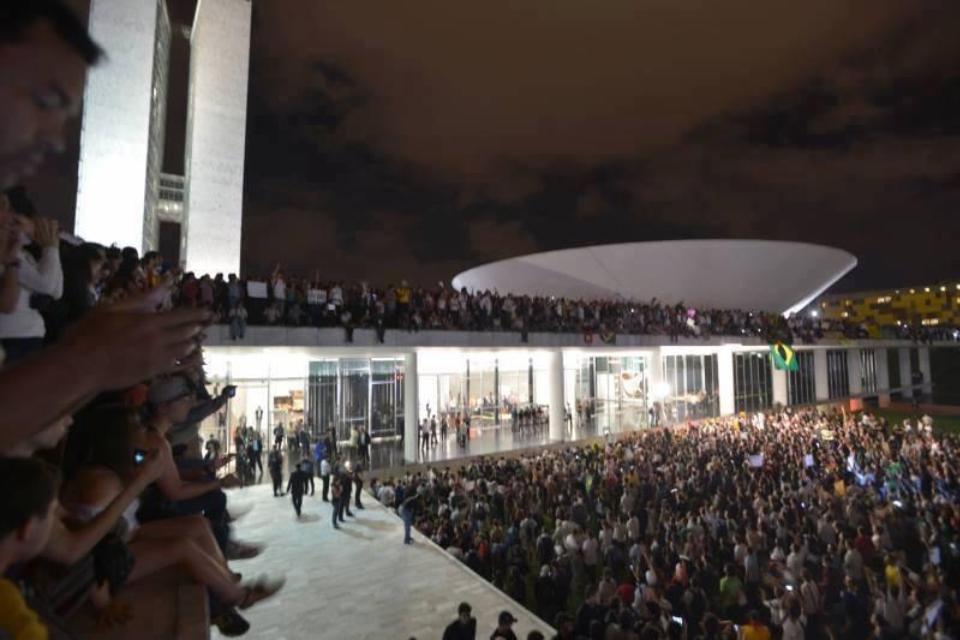
WHAT´S BEHIND THE BRAZILIAN PROTESTS?


The protests come after the opening matches of soccer's Confederations Cup over the weekend, just one month before a papal visit, a year before the World Cup and three years ahead of the 2016 Olympics in Rio de Janeiro. However, they go beyond the R$0,20 (US$0.10) raise in public transport fares. 

Brazil is currently experiencing a widespread collapse of its infrastructure. There are problems with ports, airports, public transport, health and education. Brazil is not a poor country and the tax rates are extremely high. Brazilians see no reason to have such bad infrastructure when there is so much wealth that is so highly taxed. In the state capitals people spend up to four hours per day in traffic, either in their cars or on crowded public transport which is of very poor quality.

Other than the problem of infrastructure, there are several corruption scandals which remain without trial, and the cases being judged have been tending to end with the acquittal of the defendants. The biggest corruption scandal in Brazilian history finally ended with the conviction of the defendants and now the government is trying to reverse the trial by using maneuvers through unbelievable constitutional amendments: one, the PEC 37, which will annihilate the investigative powers of the prosecutors of the public ministry (the Brazilian equivalent of the District Attorneys), delegating the responsibility of investigation entirely to the Federal Police. Moreover, another proposal seeks to subject decisions of the Brazilian Supreme Court to the Congress - a complete violation of the three powers.

More than 100,000 people took to the streets in overwhelmingly peaceful protests in at least eight cities Monday. In Sao Paulo, Brazil's economic hub, at least 65,000 protesters gathered at a small, treeless plaza then broke into three directions in a Carnival atmosphere, with drummers beating out samba rhythms as the crowds chanted anti-corruption jingles.

Hundreds of protesters in the capital, Brasilia, peacefully marched on congress, where dozens scrambled up a ramp to a low-lying roof, dancing on the structure's large, hallmark upward-turned bowl designed by famed architect Oscar Niemeyer.

In Belo Horizonte, police estimated about 20,000 people joined a peaceful crowd protesting before a Confederations Cup match between Tahiti and Nigeria as police helicopters buzzed overhead and mounted officers patrolled the stadium area. Earlier in the day, demonstrators erected several barricades of burning tires on a nearby highway, disrupting traffic.

In Rio de Janeiro, crowds clogged entire city blocks, waving Brazilian flags and chanting against corruption and for democracy.


Protests also were reported in Curitiba, Belem and Salvador.


PROTESTERS RETURNING HOME BY SUBWAY IN SAO PAULO, CHANTING THE BRAZILIAN NATIONAL ANTHEM

Friday, June 14, 2013

TAKE A MUSICAL TOUR IN SAO PAULO

Paula Lima (born in São Paulo, 1970) is a Brazilian singer and composer whose music is influenced by bossa nova, percussion, samba, Brazilian soul, and international funk music.

In this video, she gives a tour of Bexiga, a traditional bohemian neighborhood in the heart of Sao Paulo.


Monday, June 3, 2013

VALENTINE´S DAY IN JUNE?

More than any other day of the year, Valentine’s Day is a holiday exclusively dedicated to the concept of romantic love as the ideal.
When compared to other countries, you’ll find that Brazilians often have a different concept of Valentine’s Day. The most obvious contrast, for instance, involves the date on which Valentine’s Day falls in Brazil: June 12. This is done so that both Carnival and Valentine’s Day can get their own time and place. As you can see, this is a sign that people in Brazil really take Valentine’s Day seriously. If you are going to be celebrating Valentine’s Day in Brazil, you need to develop the right plan for success. 

The first thing you have to plan is the meal. Most people celebrating Valentine’s Day in Brazil will have to put some intense thought into where they will eat. Another important part of Brazilian Valentine’s Day involves giving gifts.  The best way to celebrate the holiday with gifts is to get some excellent chocolates, beautiful flowers, and perhaps a sensual massage for both of you. 
CURIOSITIES AND SUPERSTITIONS
Brazil is mostly catholic, so following Valentine´s Day is St. Anthony's Day. The Portuguese monk who died in the 13th century is a patron of matrimony. Through the centuries, girls would not only pray to St. Anthony for a husband ASAP, but also engage in less religious activities such as writing the names of three potential boyfriends on little pieces of paper and placing them under their pillow on the night of June 12 to June 13. The one they drew first in the morning would be their fate. 
A much more disrespectful custom would be bullying the image of St. Anthony as a way to threaten him to help out. A typical way of doing that would be leaving the image, upside down, behind a door, until a proper boyfriend came by! 

Monday, May 20, 2013

JORGE AMADO: A NOVELIST BIG ON STEREOTYPING BRAZILIANS


Jorge Amado is one of the best known Brazilian authors and the most translated one. His 
novels are still considered as a portrait of Brazil in the sense that they show not only the hard life of people from Bahia, but also they emphasize most of the stereotypes attributed to Brazilians. His engagement with the Brazilian literary movement called Regionalism led him to make his native land Bahia the scenery for his fiction and to incorporate in his works words closely related to the local speech. Such characteristics made Jorge Amado´s novels a very difficult work to be translated, since most of the local vocabulary, specially those related to religion, nature, social relationships and sensations or descriptions associated with the human body, seem to have no equivalence in other languages and consequently in other cultures.  

Although Brazil is the world's largest Roman Catholic nation, Amado wrote extensively 
and respectfully of the deities and rites of Candomblé, an African-derived religion 
widely practiced in Brazil. In terms of cultural importance, Amado’s works seem to be the entrance door to the Brazilian culture. 


Last year, to celebrate the centenary of his birth, there were events taking place throughout Brazil and also in cities like London, Paris, Salamanca and Lisbon.

Following are some of his works:

If you are in Salvador, Bahia, it is worth visiting the JORGE AMADO FOUNDATION


Related Posts Plugin for WordPress, Blogger...