The airborne devices are said to provide the same connection speed as the 3G network from almost 800ft in the air.
The balloons, which aim to connect regions cut off by traditional technology, have been developed by Brazil’s National Institute for Space Research as part of the government’s National Broadband Plan.
Government ministers have also reportedly been in discussions with Google, which is also piloting its internet-powered balloon initiative, called “Loon”, in New Zealand.
Paulo Bernardo, Brazil’s communications minister, said: “It will be critical to isolated towns in the Amazon region , which are not yet served by operators.”
Around 250,000 homes – some 950,000 people - are connected to the internet in Amazonas, a state that is home to 3.5 million people, according to the 2010 census.
Earlier this month, the communications ministry, along with the ministry for science, technology and innovation, launched a test balloon in Cachoeira Paulista in São Paulo.
Once in the air, attached to a vehicle, it connected via radio to a fixed point in the city and allowed two video conferences across Skype to take place.
The balloon can carry a connection for a distance of up to 30 miles (50km).
Marco Antonio Raupp, science, technology and innovation minister, added: “I hope the project continues advancing so that the most remote regions, such as the Amazon, have an effective internet signal.”
The project is similar to Google’s pilot initiative, which began in June. In the trial, 30 balloons were launched in New Zealand where 50 residents were responsible for them as “balloon pilots”, offering connections with 3G speed.
The Project Loon balloons are 50ft (15m) by 40ft (12m) and are designed to travel 12 miles (20km) above the Earth’s stratosphere, moving with the wind to provide internet coverage.
“It sounds a bit like science fiction, but we are sure the project will become a reality,” Sameera Ponda, Google engineer, said.
“Bringing internet to all with balloons is easier and cheaper than doing it through satellites.”
Representatives from the web giant met with Brazilian officials to discuss a partnership last month, according to Folha de São Paulo.
“This project would certainly contribute in a significant way to increasing internet access in an area that is difficult to reach with traditional technology,” Mr Bernardo said.
The Municipal Market of Manaus reopened after a 7-year revamp. The reopening took place along with the birthday of Manaus, which completed 344 years on Wednesday (23).
At first sight one might think of a theater, but the building was born to be a public market. It was built over three decades,since the late nineteenth century and the architecture therefore shows an eclectic mix of various styles. The central pavilion with columns made in cast iron came from Scotland and the entrance reminds us of Italian buildings. "The facade was inspired by the first shopping center in the world, the Galleria Vittorio Emanuele in Milan," says historian Liciana Gil. The original blueprints dated as far back as1881 were found two years ago by chance, in a used bookstore in Rio de Janeiro and supplied valuable information to historians. In every market there is much more history than one can think of. The cast iron spiral staircase structures, for instance, are not only beautiful to see - a closer look shows that there are hidden signs, markings of a time.
Moreover, acanthus and oak leaves, lillies are reckoned as European codes which are camouflaged in the semi-circular gate, showing how great the English influence was on the nineteenth-century Manaus; side pavilions for selling meat and fish are embellished with stained glass and iron cast lacelike lattice. The roof is covered with zinc scale tiles, the same material used on the roof of the newest of the pavilions from 1909, in which turtle meat used to be sold. "Here almost anything was sold: from drugs, to witchcraft stuff, meat, fish, turtle, and tin handcraft" says scholar Alfredo Loureiro, a member of the Center for Mustered Studies.
One hundred and eighty stallholders, some of them working there as long as half a century have started to return after the revamp. Marketer Adelaide Perente sells pink peppercorns, crabwood, all-in-one healing plants.
15,000 photographers from around the world entered the 25th edition of the award. The winning photo, "Dig Me River," is by Wagner Araujo and shows contestants at the Brazilian Championship Aquathlon running towards the Rio Negro, in Manaus, capital of the Amazon state. Photo and caption by Wagner Araujo: "I was in Manaus, Amazonas, during the Brazilian Aquathlon (swimming and running) championship. I photographed it from the water and my lens got completely wet, but there was so much energy in these boys that I just didn't worry about that". —Wagner Araujo
National Geographic Traveler Director of Photography Dan Westergren, one of this year's judges, shares his thoughts on the first place winner:
“This photo really captures my attention because of the peak action it depicts. I love the horizontal tension caused by the main subject on his way out of the picture to the right. Classic photographic rules of composition say that you should not have subjects moving out of the frame, but this shot shows that sometimes the most exciting photo can be made by breaking the rules. I also love the body language of the main subject; he's trying to lean forward but still holding back to get his last breath before plunging into the water. Finally, the addition of the tall buildings along the waterfront makes this more than just a sports picture; it’s also a portrait of Manaus, Brazil.”
Wagner won a ten-day expedition in the Galapagos Islands aboard the National Geographic Endeavour vessel. The trip is made in the company of a team of naturalists and offers the chance to get close to unique species such as giant tortoises, sea lions and marine iguanas.
The winning images will be published in the December/2013 issue of National Geographic Traveler. Location: Rio Negro, Ponta Negra Beach, Manaus, Amazon, Brazil Category: Outdoor Scenes
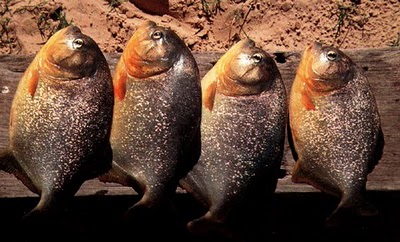
The Rio Negro River runs south by southwest through the Amazon watershed and eventually flows into the Amazon River itself. It is a dark-water river with high levels of acidity. The good news about the pH levels is that mosquitoes don't like the water. The acidity also limits aquatic diversity to only 600 species of fish (as if that's not enough) The piranha has the potential to eat any of them.
One interesting fact about the Amazon and Rio Negro rivers is that they sustain a large amount of fish that were once saltwater species. Apparently the Amazon connected the Pacific and Atlantic oceans. The eruption of the Andes Mountains closed the gates on the Pacific, and all those fish were trapped in the rivers. Some evolved into freshwater species. The black piranha can grow up to 16 pounds, and a pack of them can rip a man to shreds in seconds.
Piranha flesh is flaky and delicate, almost like a fluke. The soup is easy, quick, and done in one pot. In the Amazon and in the Pantanal it is a flavorful dish and is appreciated for its aphrodisiac quality. The soup is usually served in a bowl or cup, adding a healthy dollop of hot sauce. Some people prefer to thicken the soup with manioc flour.It is usually served as an appetizer with a side of crackers, before a fish meal or barbeque.
Want to give it a try? Here´s an easy recipe:
Ingredients:
1 onion, chopped 1 green pepper, chopped Basil, chopped Celery, chopped Parsley, chopped 2.5 kilos of medium sized piranha fish 3 cloves of garlic, chopped Malagueta pepper, chopped 2 bay leaves 1 cup of coconut milk Salt 1 teaspoon of saffron
How to prepare: Scrub the skin of the piranhas to remove the scales, clean the insides and remove the eyes. Cut them open lengthwise and boil them with the heads in two liters of water with no other ingredients. Boil until the meat comes off the bones. Strain the broth to remove the fish bones that are quite small and sharp. Reserve the broth. Chop the onion, pepper, garlic, salt to taste, olive oil and saffron in a blender. Sautee the mixture in another pan. Add the piranha broth and let it boil. After a while, add two bay leaves, the coconut milk, basil and malagueta pepper and boil a little bit longer. The soup is ready when all the flavors and ingredients have blended well. Add the parsley just before serving.
Yes, you
read it right. A group of Brazilian scientists has been studying over 30 years the
air masses which drift from the Amazon region and carry humidity to other
regions of Brazil. The vapour volume conveyed by these flying rivers can be
bigger than the discharge of all Brazilian mid-western rivers altogether
reaching astonishing 200,000 cu m/s. In other words an amount of water equivalent
to the Amazon river discharge may pass over our heads in one second. Still, according
to researches a single large tree alone can
transpire 12,000 gallons of water a day. The Amazon
rain forest works as a water pump drawing to the continent all humidity
evaporated from the Atlantic ocean. This humidity becomes rain and falls over
the rainforest itself.
To show how these flying rivers bring rain to Brazil and South America, British-born pilot Gerard Moss flies aboard
his single-engine Embraer 721 aircraft above the Amazon rainforest "Climate change is taking its toll. The
United States is going through its worst drought in half a century, Russia is
also reeling from drought and in India monsoon rains have for years been
irregular," he said. "Brazil is less affected because we have the
world's biggest tropical forest, which helps regulate the climate."
Deforestation is, however, an important counterfactor.
With logging and agriculture shrinking Brazil's rainforests, there are fewer
trees to release the water vapour that creates these flying rivers. Scientists believe nearly
20% of the Amazon has been destroyed and some fear a point of no return if
destruction reaches 35% to 40%. Large-scale deforestation has made Brazil one of
the world's top greenhouse gas emitters, but the government has vowed to curb
it and has made significant strides in the past decade. Brazilian authorities confirmed earlier this year
that deforestation fell to a record low of 6 418 km² in 2011, down from a peak
of 27 000km² in 2004.
The pororoca (Portuguese pronunciation: [poɾoˈɾɔkɐ]) is a tidal bore, with waves up to 6 metres high that travel as much as 13 km inland upstream on the Amazon River and adjacent rivers. Its name comes from the indigenous Tupi language, where it translates into "great destructive roar". It occurs at the mouth of the river where river water meets the Atlantic Ocean. As the fresh water from the river is less dense than the ocean water, it overlaps the rising tide therefore delaying it. At some point the balance is disrupted, and together with the winds the wave grows and spreads over inland, thus inverting the river current. The phenomenon is best seen in February and March.
The wave has become popular with surfers. Since 1999, an annual championship has been held in São Domingos do Capim (on the adjacent Guamá River). However, surfing the Pororoca is especially dangerous, as the water contains a significant amount of debris from the shores of the river (often entire trees), in addition to dangerous fauna.
Wave height: 3 to 6 meters
Wave run: 40 minutes How often: every 12 hours
Distance covered: 30 km in over one and a half hour Speed: approx. 20 km/h
Carnival in the Amazon is in June - it epitomizes the voices and colors of the jungle. Here, there are only two contestants, represented by blue and red colored bulls, namely Caprichoso and Garantido. It´s a must see of the Brazilian folklore.


 The airborne devices are said to provide the same connection speed as the 3G network from almost 800ft in the air.